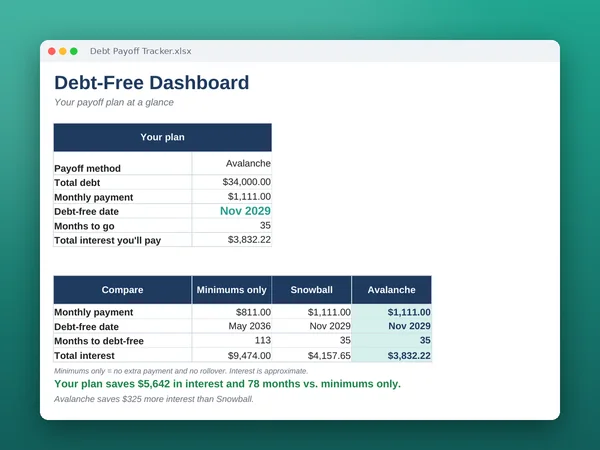
If you have more than one debt, the order you pay them off in matters. Pay the minimum on everything and you can be in debt for a decade. Pick a strategy, put every spare dollar behind it, and the same debts can be gone in under three years.
The two most popular strategies are the debt snowball and the debt avalanche. Both work. They just reward you in different ways.
How both methods work
The setup is identical for both:
- List every debt with its balance, interest rate (APR) and minimum payment.
- Decide on one total amount you can pay toward debt every month.
- Pay the minimum on every debt, and put everything left over on one target debt.
- When the target is paid off, roll its whole payment onto the next target. Your payment grows every time a debt disappears.
The only difference is which debt you target first.
The debt snowball: smallest balance first
With the snowball you attack the smallest balance first, regardless of interest rate. A $600 store card goes before a $9,000 car loan.
Why people love it: you get a win fast. Wiping out a whole debt in the first month or two is motivating, and motivation is what keeps people going for the two or three years it takes.
The catch: if your biggest debt also has the highest rate, you'll pay a bit more interest overall.
The debt avalanche: highest interest rate first
With the avalanche you attack the debt with the highest APR first, usually a credit card, regardless of balance.
Why it's mathematically best: every dollar goes where it's costing you the most, so you pay the least interest and usually finish a little sooner.
The catch: if your highest-rate debt is also a big one, it can be months before you see a single debt hit zero, and that's where many people give up.
A real example
Say you have four debts totalling about $25,000 and you can pay $875 a month:
| Debt | Balance | APR | Minimum |
|---|---|---|---|
| Credit card | $6,800 | 24.9% | $170 |
| Store card | $850 | 19.9% | $35 |
| Car loan | $3,200 | 6.9% | $210 |
| Student loan | $14,500 | 5.5% | $160 |
Run both methods and the avalanche finishes about a month sooner and saves a few hundred dollars in interest. Paying only the minimums, the same debts would take almost ten years and cost over $12,000 in interest. Either method beats minimums by a mile.
Which one should you choose?
- Choose the avalanche if you're motivated by numbers and the interest difference is large (a high-rate card with a big balance).
- Choose the snowball if you've tried before and lost steam, or you have several small debts you can clear quickly.
- When the difference is small (under a few hundred dollars), pick the one you'll stick with. Consistency beats optimization.
Make it stick
Whichever you choose, three habits make the difference: automate the minimum payments so nothing is ever late, stop adding new debt to the cards you're paying off, and check your progress once a month. Watching the balances fall is what keeps you going.